Pack the kit
Free course · About 25 minutes · 4 lessons
Corporate souvenirs that get used
How to choose a gift people keep, set the quantity, and know when you are ordering and when you still need design.
After this course
- Decide whether an item will be used after the day, before you spend.
- Build a small kit people carry, instead of a bag of leftovers.
- Set a quantity and a lead time that match the guest list you actually have.
- Know when the logo is ready to print and when you still need a design quote.
For hR, administration, and project teams ordering gifts and kits. Works for a conference, a staff gift, a donor visit, or a field kit.
- Souvenirs
- Events
01
6 min read
When a souvenir earns its place
A souvenir earns the budget when someone will carry it, write in it, wear it, or drink from it after the day. A box that goes from the printer to a store cupboard is a cost with a logo on it. Start with the week the person is already living, and choose the object that fits that week.
The person matters more than the catalogue. A conference delegate needs a pen that writes and a notebook they can open in the session. A field officer needs a bag that survives the road. A staff gift at the end of the year can be one better item. A visitor who is in the building for an hour does not need a five-piece kit.
Match the item to the relationship. Staff, guests, beneficiaries, and donors are not the same list. A beneficiary kit should be useful without turning the person into an advertisement. Ask permission before you photograph someone with the item for a post.
If you cannot say where the item will be next month, do not order it yet. Spend the same money on the thing the day actually needs: the badge, the backdrop, the programme, the water.
Ask this before you order
- Name the person: staff, guest, delegate, donor, or beneficiary.
- Name the use after the day: write, carry, wear, or drink.
- Reject any item whose next home is the store cupboard.
- Keep beneficiary items useful, and get consent before you photograph people.
- If the list of uses is empty, spend the money on the event itself.
02
7 min read
The useful set
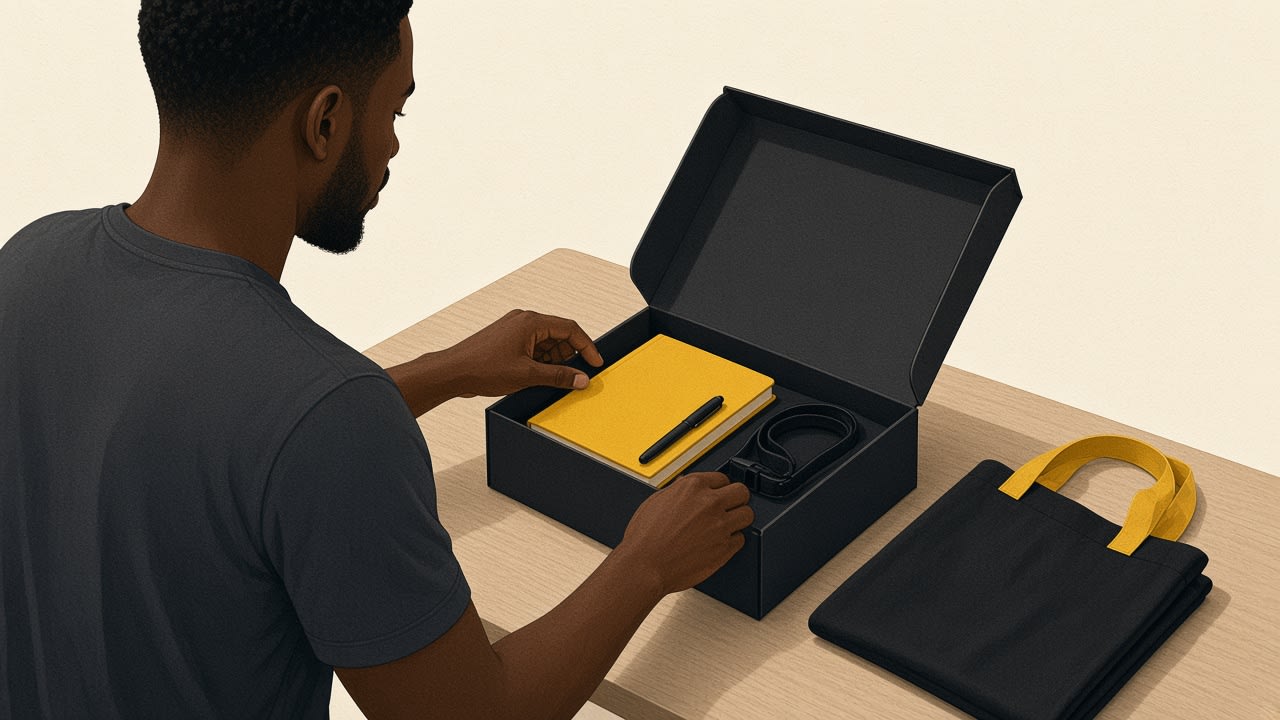
A conference pack that gets used is usually four things: a pen, a notebook, a tote, and a lanyard with a badge. That set covers the session, the walk back, and the name at the door. Add a fifth item only when you know it will be used. A mug or a flask is worth it when the production time allows and people will actually take it home. It is a leftover when it was added to make the bag look full.
Match the colours to the organisation, and put the logo where it can be read without covering the part people hold. A logo across the grip of a pen, or so large on a shirt that nobody will wear it on a weekend, fights the gift. Small, sharp, and in the right place lasts longer.
Quality is the difference between a gift and a joke. The pen has to write. The bag has to hold a notebook and a bottle. The notebook has to open flat enough to take notes. Order one sample, use it for a day, and only then approve the run.
One artwork should work on the pen, the bag, the badge, and the backdrop. If the logo changes size and colour on every item, the table looks like four different organisations arrived.
Build the kit from these
- Start with a pen, a notebook, a tote, and a lanyard.
- Add a mug or a flask only when the date allows the production.
- Keep the logo readable, off the grip, and consistent across items.
- Use one sample yourself before you approve the full quantity.
- Use one artwork for the kit, the badge, and the room.
03
7 min read
Quantity, names, and the lead time
Order for the people who will attend, plus a small spare for replacements and staff. Doubling the quantity “just in case” fills the cupboard. A roadshow with an unknown crowd is the exception: set a cap, and decide in advance what happens when you hit it.
Names need a locked list. Badges, certificates, and personalised notebooks cannot be guessed at the printer. Agree the spelling, the order of the names, and the hour the list stops changing. Every name added after that hour is a separate, slower job.
Lead time follows the object. A stock pen with a one-colour print is faster than a custom-colour bag, an imported flask, or embroidery. Say the date the goods must be in the room, then work backwards. If the date cannot hold the object you want, change the object. Do not pretend the ship will be early.
Write the delivery place as a room, not only a city. “Accra” is not an address. The hall, the office, the gate, and a phone number for the person who will receive and count.
Lock these numbers
- Quantity equals the real list, plus a small spare.
- A cap for open events, and a rule for when you stop handing items out.
- A locked name list, with the hour it stops changing.
- An in-room date that the object can actually meet.
- A room, a receiver, and a phone number, not only a city.
04
6 min read
Order it, or have it designed
If the logo, the colours, and the placement are already decided, you are ordering. Send the print file, the quantity, and the date. Approving a photo of the sample is the last creative step.
If someone still has to place the logo, choose the colour, or make the items look like one family, that is design. It is usually quoted at GHS 300–800, on its own, before production starts. Paying for design after the goods are made means paying to live with a mistake.
Keep the path short. One person sends the file. One person approves the sample. A committee that reviews the pen by WhatsApp voice note will still be reviewing it when the event has started.
The same artwork should be ready for the social post and the backdrop. If the kit, the room, and the photograph each get a new version of the logo, the organisation looks unfinished on the day it most wants to look ready.
Choose one path
- Ready logo and colours: order, and approve a sample.
- Logo still to place: a design quote of GHS 300–800, agreed first.
- One sender and one approver, named before the file goes out.
- One artwork reused on the kit, the room, and the post.
- No new version of the logo once the sample is signed.
New courses by email
When a course is added, it goes to this address.